
Polyacrylamide (PAM) is a cornerstone of modern industrial chemistry, serving as an irreplaceable water-soluble polymer across municipal, agricultural, and resource-extraction sectors. Synthesized primarily from acrylamide monomers (-CH2CHCONH2-), the core mechanism relies on free-radical chain polymerization. The process initiates via chemical catalysts, thermal decomposition, or radiation, forcing the carbon-carbon double bonds of acrylamide monomers to open and join sequentially, creating high-molecular-weight linear chains. What makes PAM fascinating is not just its basic chemical structure, but how precise structural adjustments during production can fundamentally shift its performance characteristics.
The Spectrum of Molecular Weight
A critical differentiator in production is controlling the molecular weight (MW). For applications requiring low viscosity or specialized dispersant characteristics, short polymer chains are targeted. However, for industrial flocculation, producers aim for ultra-high molecular weights, sometimes exceeding 20 million Daltons. Achieving this requires rigorous control over monomer purity, temperature profiles, and reaction rates to ensure that chains grow seamlessly without premature termination.
Tailoring Charge Density: Anionic, Cationic & Non-ionic Forms
Beyond chain length, modifying the polymer’s electrical charge is what gives polyacrylamide its versatile industry profiles:
Produced by co-polymerizing acrylamide with acrylic acid or through partial hydrolysis of non-ionic PAM. This imparts negative charges along the backbone, making it exceptional at binding positively charged metallic particles, minerals, and silts.• Anionic PAM (APAM):
Synthesized by introducing cationic monomers like DAC (acryloyloxyethyl trimethyl ammonium chloride). The resulting positive charge is highly effective at neutralizing negatively charged organic matter, making it the premier choice for municipal sludge dewatering and organic wastewater systems.• Cationic PAM (CPAM):
The pure homopolymer format possesses minimal surface charge. Its efficiency relies heavily on hydrogen-bonding networks, making it well-suited to highly acidic environments or asymmetric mineral suspensions.• Non-ionic PAM (NPAM):
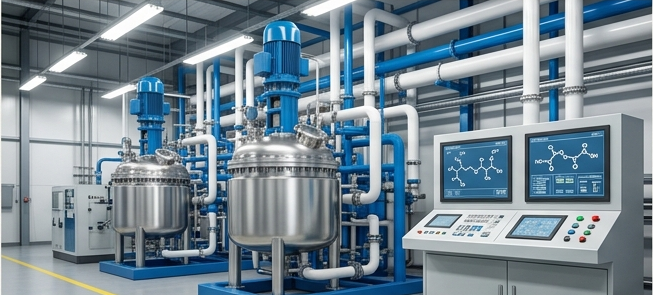
| Technical Note from the Lab In the manufacturing facility, the physics of polymerization dictates final utility. Even a minor variance in raw monomer purity can lower molecular weight by millions of Daltons, drastically reducing flocculation efficacy. |